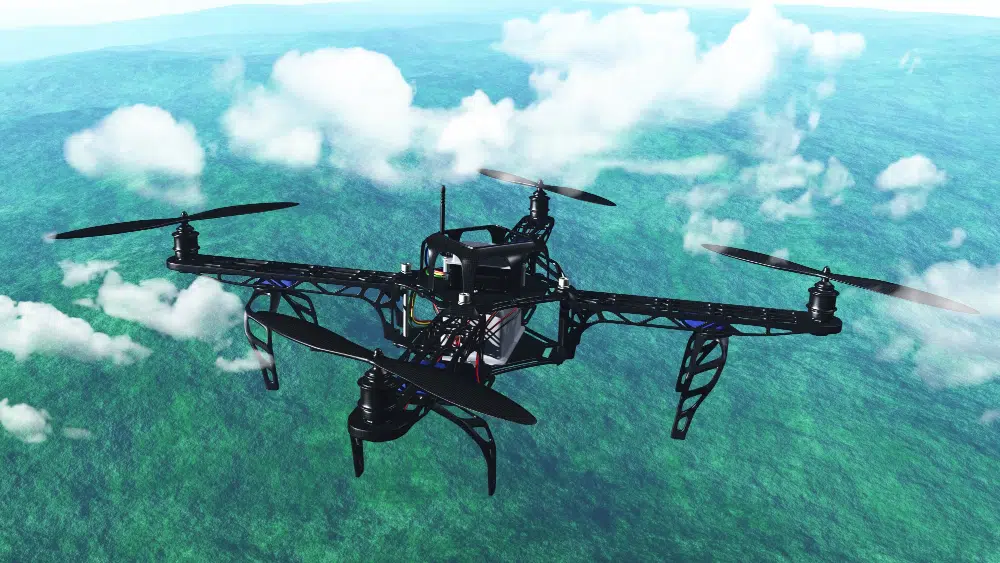
Drones and artificial intelligence (AI) are the most significant tactical evolution since World War II – rapidly rewriting the rules of modern warfare and creating concerns that humans are being removed from the decision-making process.
The latest conflict to make use of drones erupted at the end of February after the US and Israel launched strikes on Iranian military and nuclear targets following the failure of talks over Iran’s nuclear programme.
Iran responded with waves of ballistic missiles and drones aimed at Israeli and regional targets, with US president Donald Trump warning the war could last as long as five weeks. This, amid an ongoing war between Russia and Ukraine after Russia invaded the east European country in February 2022.
The use of drones and AI in warfare “represents the most significant tactical evolution since the invention of the precision-guided munition” in the second World War, says Mark Walker, director at T4i and previously SA MD for IDC. He adds that the “battlefield has expanded exponentially”.
Professor HB Klopper, academic head at Belgium Campus iTversity, says recent conflicts illustrate how drones have become central to modern warfare. “Warfare has entered a new technological era, with drones rapidly becoming one of the most influential tools on the battlefield.”
In November, Just Security, an online forum based at the Reiss Centre on Law and Security at New York University School of Law, highlighted that drone attacks in conflict settings increased by 4 000% between 2020 and 2024, and more than quadrupled from an estimated 4 525 attacks in 2023 to 19 704 in 2024.
Digital combat
Walker notes that warfare has moved beyond systems where technology simply supported soldiers. “We have officially moved beyond the era of ‘digitised’ combat – where technology merely assisted the soldier – into the age of ‘AI-native’ warfare, where algorithmic speed has become the decisive force on the ground.”
Modern systems increasingly rely on networks that combine command, control, communications, computers, cyber, intelligence, surveillance and reconnaissance capabilities to coordinate battlefield activity, says Walker.
Drones were initially developed for reconnaissance missions that allowed militaries to observe enemy positions without risking pilots’ lives, says Klopper, but their role has expanded significantly as costs have fallen and capabilities improved.
Budget-friendly
The evolution of weapons technology has turned warfare into an increasingly remote affair, says ICT commentator Adrian Schofield. “In the 19th century, soldiers were cheap – as long as you had enough of them to keep the front line in motion, you could win the battle. Now, drones are cheap. And they don’t have to look the enemy in the eye.”
Walker notes that the rapid development of relatively inexpensive drones and missiles is changing the economics of warfare, with expendable, networked systems and componentry being designed to overwhelm expensive, traditional platforms like carriers and main battle tanks.