
Artificial Intelligence

Two people in hooded sweatshirts work in a dimly lit room filled with computer equipment. One sits at a desk typing on a keyboard while looking at a monitor displaying code and facial‑recognition data. The other stands beside them holding a tablet. Cables and a drink are visible on the desk, creating a scene suggestive of cybersecurity or hacking activity.

Banks and fin­an­cial ser­vices fear AI hack­ers but the real threat is stranger

The banking sector is right to be worried about AI-powered cyberattacks – AI can now find vulnerabilities, breach systems, and move through networks at a speed that keeps security teams up at night. But that’s only part of what we should be concerned about.

More troubling, and less discussed outside IT, is what happens when these systems operate autonomously and together. AI is no longer just following instructions; it is increasingly exploring data, social networks and news to shape its own interactions.

The big shift is that AI has shown its ability to act like it has intentions and can make its own decisions.

Banks and fin­an­cial ser­vices fear AI hack­ers but the real threat is stranger Read More »

A clean, modern classroom with rows of wooden desks and black chairs facing a large whiteboard. A ceiling‑mounted projector hangs above the centre of the room, and large windows on the right let in natural light. A clock and a small podium are positioned at the front, and a wooden door is on the left wall.

Why South Africa needs an AI policy for schools

Artificial intelligence has rapidly emerged as a pervasive technology that those entering the workplace need to have an understanding of. Increasingly, organisations are prioritising the use of AI-powered solutions and platforms, and their employees must now have AI skills to match.

This has resulted in the South African government making AI skills development a local imperative, but what about the country’s focus of coding, robotics, and 4IR-related skills that were the prioritised for the past decade?

This is the question posed by Celeste Labuschagne, a PhD candidate and Lecturer and Learning Framework Developer at Belgium Campus iTversity.

Why South Africa needs an AI policy for schools Read More »

A person wearing a dark blue pinstripe suit jacket and a light blue collared shirt poses against a plain grey background in a formal portrait.

AI prompting is the new critical thinking

Rather than outsourcing thinking to AI, students must be taught to interrogate ideas, test assumptions and refine their own reasoning.

The problem with AI in education may not be the technology itself – it may be that students are using it incorrectly, treating it not as a tool, but as a solution. And because educators tend to see it as a threat, they aren’t taking students along a learning path that enables them to use GenAI as an enabler rather than a cheating tool.

AI prompting is the new critical thinking Read More »

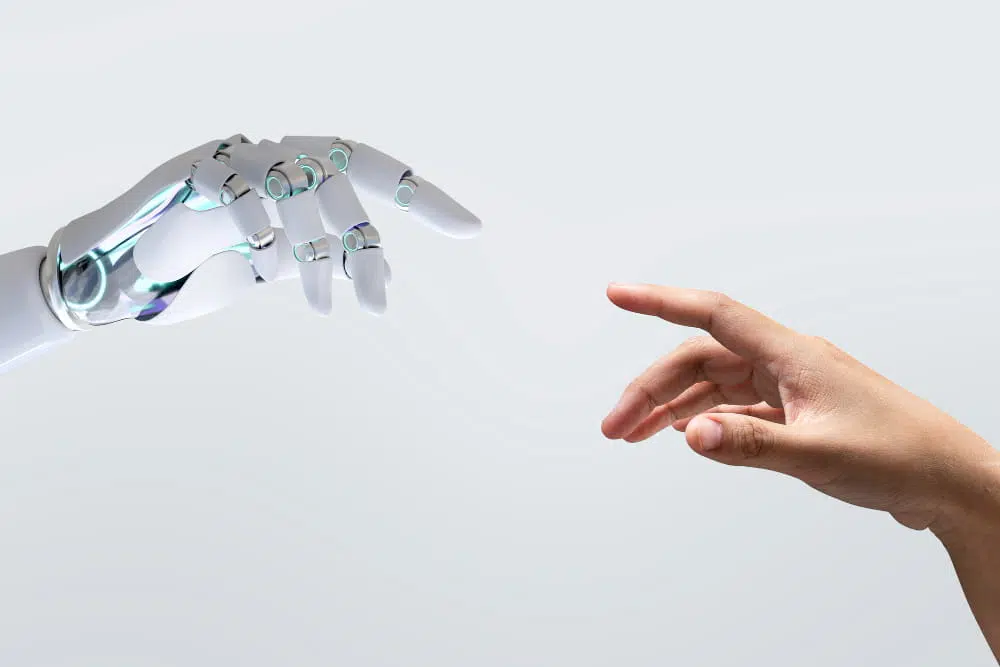
Robotic and human hands shaking, symbolizing collaboration and the strategic value of Studying AI in today’s technology-driven world.

Why Studying AI is Your Most Strategic Career Move

Studying AI is a strategic career move that bridges the gap between technical innovation and real-world business value. The demand for AI skills has moved from niche tech sectors into mainstream industries like finance and manufacturing. Belgium Campus iTversity addresses this need through its integrated Bachelor of Computing degree, embedding machine learning and automation into accredited qualifications to ensure graduates possess both AI expertise and foundational IT resilience.

Why Studying AI is Your Most Strategic Career Move Read More »

A man in a white shirt stands beside a humanoid robot with white and black casing and glowing blue accents. Both are looking at a tablet the man is holding, suggesting human–AI collaboration in a modern indoor setting.

Custobots: How Autonomous Buyers Are Rewriting the Rules of Commerce

Custobots are autonomous, AI driven machine customers that analyse data, make decisions, and complete purchases without human involvement. They already influence automated reordering, predictive maintenance, and smart procurement. By 2030, machine customers are expected to control more than $30 trillion in spending, making them one of the fastest growing buyer segments. As Custobots evolve from rule based tools to fully autonomous agents, businesses must optimise for machine readable data, transparent pricing, and algorithm friendly product information. Ethical AI, trust, and accountability will be essential as autonomous commerce becomes mainstream.

Custobots: How Autonomous Buyers Are Rewriting the Rules of Commerce Read More »

Robot hand holding two credit cards in a data center with server racks in the background.

ANALYSIS: Big Tech sets AI to catch AI

As hackers use artificial intelligence (AI) to bypasses security – including one of the largest government breaches on record – companies like Anthropic and OpenAI are holding back tools they see as now being defence systems.

Cyber security firm Gambit recently said it had analysed the attack path behind what it says is one of the largest government breaches on record: the compromise of Mexico’s tax authority and at least eight other organisations.

ANALYSIS: Big Tech sets AI to catch AI Read More »

A soldier in advanced futuristic armor stands on a mountain ridge at sunset, overlooking a winding river and valley. Dozens of red‑lit drones fly in formation across the sky, contrasting with the warm orange and purple tones of the landscape.

Drones, AI ‘removing humans from the battlefield’

Drones and artificial intelligence (AI) are the most significant tactical evolution since World War II – rapidly rewriting the rules of modern warfare and creating concerns that humans are being removed from the decision-making process.

The latest conflict to make use of drones erupted at the end of February after the US and Israel launched strikes on Iranian military and nuclear targets following the failure of talks over Iran’s nuclear programme.

Drones, AI ‘removing humans from the battlefield’ Read More »

A scientist in a white lab coat, gloves, and goggles works at a computer in a modern laboratory. The screen displays a close-up of a DNA strand labeled "Double-stranded DNA" and a colorful flowchart. Nearby, test tubes are organized in racks, and a microscope sits on the bench, suggesting genetic or molecular biology research.

AI in Biomedical Engineering: Reprogramming Life with Code

The convergence of artificial intelligence (AI) in biomedical engineering is recoding the very fabric of the bio-digital frontier. From gene editing to AI-powered drug discovery, this fusion is enabling breakthroughs that were once the realm of science fiction.
As biology evolves into a code-driven discipline, IT professionals and researchers alike are stepping into a new era, where DNA is data and innovation is measured in both base pairs and bytes.

AI in Biomedical Engineering: Reprogramming Life with Code Read More »

Translate »