
Varsity teams gear up for Sasol Solar Challenge with innovative SOL-1
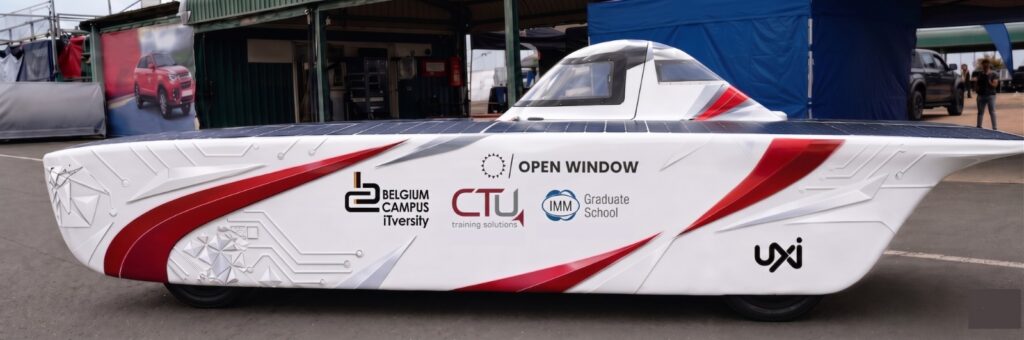
SOL INVICTUS Dynamics, a multi-institutional solar car team, is gearing up to compete in the Sasol Solar Challenge 2026 with its solar-electric vehicle, SOL-1.
The project brings together students, lecturers and industry mentors from Belgium Campus iTversity, CTU Training Solutions, IMM Graduate School and Open Window, in an initiative focused on sustainable engineering, innovation, and experiential learning.
The Sasol Solar Challenge is an eight-day biennial endurance event in which local and international engineering teams race custom, solar-powered vehicles across public roads in South Africa. The 2026 event takes place from 10 to 17 September, starting in Sasolburg and traveling a minimum distance of about 2,500 km toward Cape Town.
Francois Venter, Project Lead of International at Belgium Campus iTversity, and project manager of SOL INVICTUS, says the premier solar-powered motorsport event provides students with the opportunity to apply their skills in a real-world engineering environment.
Skills mix
“Working alongside academic staff and industry mentors, students are gaining practical experience while contributing to a complex engineering project as they enter the final stages of preparatory work with just six weeks to go ahead of the challenge,” says Venter.
Sasol’s Solar Challenge aims to be the ultimate test of technology and innovation, with local and international teams conceptualising, designing and building solar-powered vehicles to achieve the most kilometres on their vehicles as they demonstrate design, manufacturing, and strategy skills.
“Because of the nature of skills required to successfully – and safely – compete, we have brought together students and academics from a range of disciplines including software engineering, intelligent computing, mechanical and electrical engineering, marketing, business management, visual communication, and industrial product design,” says Venter.
The flagship SOL-1 incorporates a lightweight composite structure, high-efficiency solar panels, an electric drivetrain, and advanced energy management technologies designed to maximise performance and efficiency.
“SOL-1 is a tangible platform for innovation in renewable energy, vehicle efficiency, battery management, telemetry, and intelligent control systems,” says Venter.
Beyond the classroom
Venter explains that the project reflects a shared commitment to developing future-ready, versatile skills while promoting sustainable engineering solutions in a real-world demanding environment.
Beyond the technical aspects of the vehicle, the initiative aims to raise awareness of renewable energy and the role that young innovators can play in addressing future challenges.
Venter adds that the SOL-1 team aims to showcase South African skills in developing sustainable solutions through their trip across the country. “Through teamwork, creativity and problem-solving, the team hopes to showcase, the team hopes to showcase the potential of student-led innovation on a national platform,” says Venter.
About SOL INVICTUS Dynamics
SOL INVICTUS Dynamics is a multi-institutional solar car team comprising students and staff from Belgium Campus iTversity, CTU Training Solutions, IMM Graduate School and Open Window. The team was established to provide students with practical experience in sustainable engineering and innovation while competing in the Sasol Solar Challenge 2026. Through collaboration, creativity and technical excellence, the team is committed to showcasing the power of multidisciplinary learning and renewable-energy innovation.
- Press release on behalf of Belgium Campus iTversity

By this year, attackers were using AI to scale and accelerate cyber crime, which extends from generating code and automating attacks, to crafting convincing phishing and deepfake scams. The AI Incident Database lists more than 7 000 incidents in which AI was used as a hacking tool.