
SOL INVICTUS puts AI-enabled solar car through its paces at Zwartkops
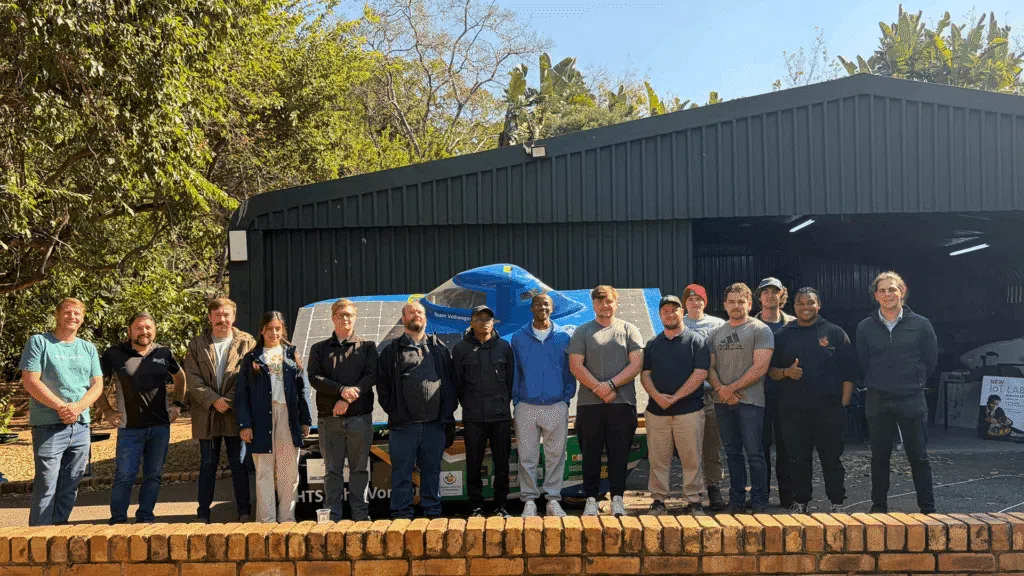
Belgium Campus iTversity and its SOL INVICTUS partners are evaluating an advanced AI-powered telemetry system ahead of the Sasol Solar Challenge.
The solution, developed by students in collaboration with industry and academic partners, makes it possible for their solar-electric race car and support vehicle to operate as a single connected mobility platform and will be live tested at Centurion-based Zwartkops Raceway as the team prepares for South Africa’s premier solar-powered motorsport event.
Sasol’s Solar Challenge is an eight-day biennial endurance event in which local and international engineering teams race custom, solar-powered vehicles across public roads in South Africa between 10 and 17 September. The race starts in Sasolburg and travels a minimum distance of about 2,500 km to Cape Town via Jeffreys Bay.
The SOL INVICTUS team, a collaboration between Belgium Campus iTversity, CTU Training Solutions, Open Window Institute, and IMM Graduate School, has developed a Neural Network for its solar-electric vehicle, SOL-1.
The Neural Network enables real-time communication between the team’s solar car, SOL1, and its chase vehicle, providing live insights that support race strategy, efficiency, and safety.
One network to rule them all
Francois Venter, Project Lead of International at Belgium Campus iTversity, and project manager of SOL INVICTUS, explains that the Neural Network uses a combination of telemetry, wireless communications, edge computing and artificial intelligence (AI).
“Through these technologies, our solution continuously monitors battery performance, energy consumption, solar energy generation, location, route information, and environmental conditions. This information is transmitted and analysed in real time, allowing the team to make informed decisions while the vehicle is in motion,” says Venter.
Venter adds “this project demonstrates how industry collaboration and real-world learning can equip students with the skills needed to develop the next generation of intelligent mobility solutions”.
Bringing it all together
Rather than simply displaying vehicle information, the platform transforms incoming data into actionable intelligence, giving the race team a single system that sharpens situational awareness and supports decisions in real time.
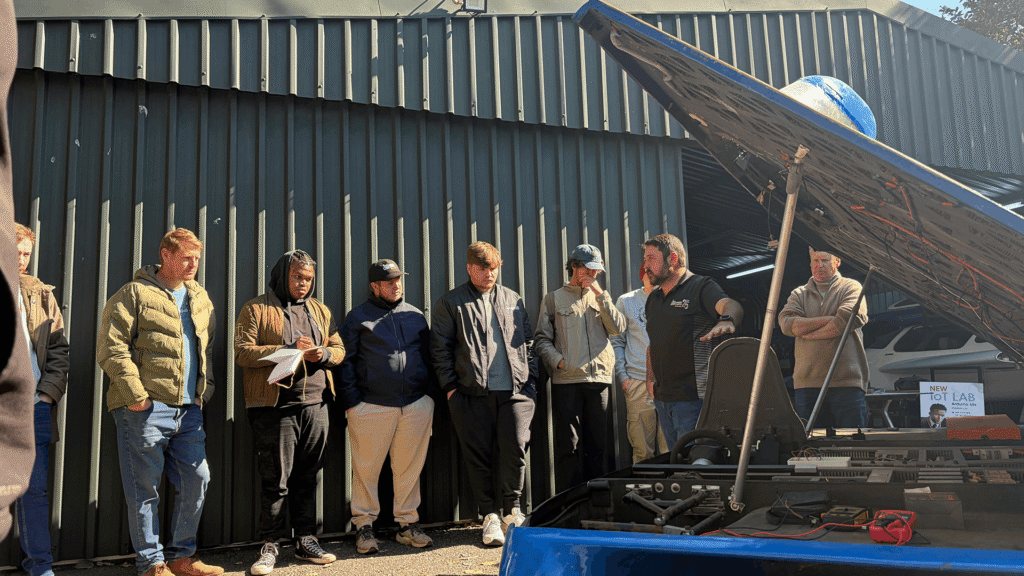
Team members monitor performance through live visualisation dashboards, spotting trends and responding faster to changing race conditions.
A key capability is the system’s predictive analytics. By analysing weather conditions, GPS positioning, elevation changes and historical performance data, the platform forecasts future energy requirements, feeding directly into race strategy.
The future of connected mobility
Venter says the project forms part of broader student-led research into connected mobility, where vehicles, sensors, AI, and digital platforms work together to improve decision-making and operational efficiency.
Recent developments have explored areas such as environmental monitoring, driver alertness systems, biometric analysis, and predictive intelligence.
“This approach reflects the future of mobility, where vehicles increasingly interact with intelligent technologies, external systems, and human operators to create safer, smarter, and more efficient transportation networks,” says Venter.
The live tests will evaluate:
- Real-time communication between the solar car and chase vehicle.
- Live performance monitoring and visualisation.
- Environmental sensing and data collection.
- Communication reliability and responsiveness.
- AI-powered predictive analytics and decision support.
The Zwartkops test represents a critical step in validating the technology and preparing both the team and vehicle for competition, while showing how hands-on training and industry teamwork can deliver practical solutions for the mobility technologies of the future.
“For Belgium Campus iTversity and its partners, the Neural Network is more than a race technology project. It is a living laboratory where students gain tangible experience in AI, telemetry, data analytics, systems integration, software development, and intelligent mobility,” says Venter.
About SOL INVICTUS Dynamics
SOL INVICTUS Dynamics is a multi-institutional solar car team comprising students and staff from Belgium Campus iTversity, CTU Training Solutions, IMM Graduate School and Open Window. The team was established to provide students with practical experience in sustainable engineering and innovation while competing in the Sasol Solar Challenge 2026. Through collaboration, creativity and technical excellence, the team is committed to showcasing the power of multidisciplinary learning and renewable-energy innovation.
- Press release on behalf of Belgium Campus iTversity

By this year, attackers were using AI to scale and accelerate cyber crime, which extends from generating code and automating attacks, to crafting convincing phishing and deepfake scams. The AI Incident Database lists more than 7 000 incidents in which AI was used as a hacking tool.