Vertical Farming: How Technology Could Help Secure South Africa's Food Future
At A Glance
Vertical farming is transforming the future of food production in South Africa by combining technologies such as AI, automation, IoT and hydroponics to grow crops more efficiently in controlled environments. By using significantly less water and land than traditional farming methods, vertical farming offers a sustainable solution to challenges such as climate change, urbanisation and food insecurity, while creating new opportunities in both agriculture and technology.
When Food Security Meets Innovation
South Africa faces a growing challenge: how do we sustainably feed a rapidly urbanising population in a country increasingly affected by water scarcity, climate volatility, and pressure on agricultural resources?
Rising temperatures, changing rainfall patterns, droughts, and extreme weather events continue to place strain on traditional farming methods and food production systems. At the same time, food insecurity remains a significant concern, particularly as urban populations continue to grow and food prices fluctuate.
The solution may not lie in expanding farmland – it may lie in reimagining how food is produced altogether.
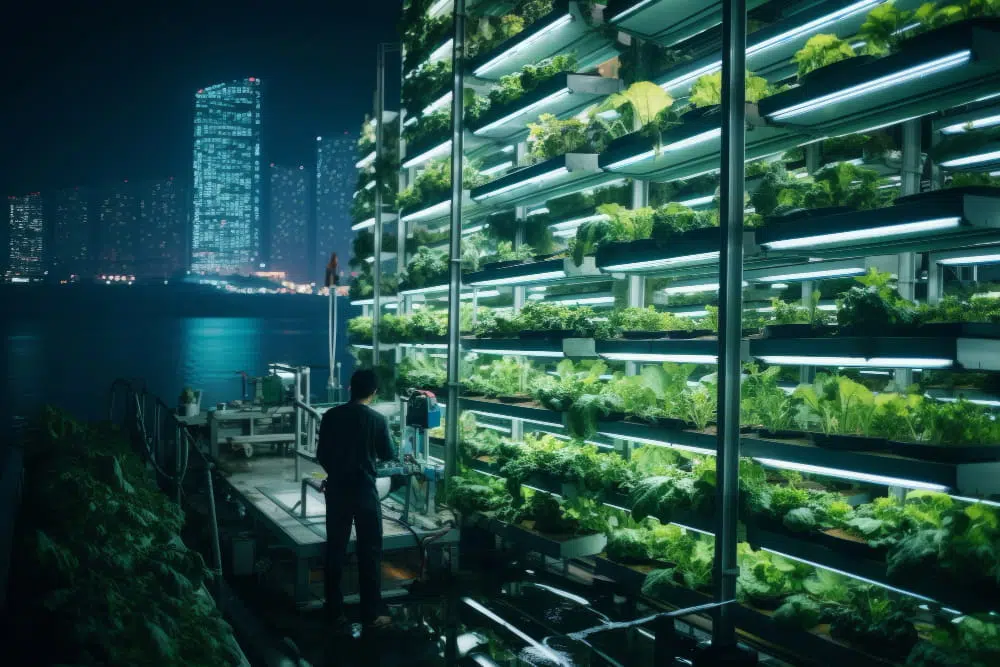
Enter vertical farming: a technology-driven approach to agriculture that combines artificial intelligence (AI), data analytics, automation, hydroponics, aeroponics, and controlled-environment systems to produce food more efficiently and sustainably.
While vertical farming has become a global talking point, its potential is particularly relevant in South Africa, where technology could play a critical role in building more resilient and productive food systems.
A South African Solution to South African Challenges
South Africa’s agricultural sector is facing a unique combination of pressures. Water scarcity remains one of the country’s most pressing environmental challenges. Climate change is increasing the frequency of droughts and extreme weather events, while urban growth continues to reduce available agricultural land around major cities. These factors threaten crop yields, increase food prices, and place long-term pressure on food security.
Vertical farming offers an alternative approach. Instead of growing crops across large expanses of land, food is cultivated in vertically stacked layers within controlled environments such as warehouses, greenhouses, shipping containers, and urban facilities. This allows food to be grown closer to consumers while using significantly less land and water than conventional farming methods.
For rapidly growing urban centres such as Johannesburg, Pretoria, Cape Town, and Durban, vertical farming presents an opportunity to strengthen local food production while reducing the logistical challenges associated with transporting produce across long distances.
South African Success Stories: Technology in Action
Vertical farming is often portrayed as a future innovation, but across South Africa, businesses and communities are already demonstrating what is possible when technology and agriculture work together.
Arable Grow: Farming with IoT and Big Data
Stellenbosch-based Arable Grow combines hydroponic farming with IoT automation and cloud-based data systems to optimise crop production. Using in-house technology development and automation specialists, the company produces fresh crops year-round while reducing water and land usage.
Its operating model leverages real-time data, same-day harvesting and delivery, and technology-driven production processes to create a more efficient agricultural system.
Delta Dawn: Urban Agriculture in Pretoria
In Pretoria, Delta Dawn Hydroponic Farm has been successfully producing organic leafy greens using aeroponic and vertical farming techniques since 2015.
By operating within an urban environment and utilising innovative growing technologies, the farm demonstrates how food can be produced sustainably within cities while maintaining consistent output and quality.
Future Farms SA: Community Empowerment Through Technology
Future Farms SA has developed and supported multiple hydroponic and controlled-environment farming projects across South Africa.
One notable project involved the development of a hydroponic vegetable farm in Touws River, which incorporated climate controls, fertigation systems, technical training, and infrastructure development to support local food production and create employment opportunities. The organisation has also participated in urban rooftop farming initiatives designed to improve food security and support entrepreneurial development.
These examples demonstrate that vertical farming is not merely a concept – it is already delivering practical benefits in South African communities.
Climate as a Controlled Variable
For generations, farmers have depended on weather patterns to determine planting cycles, irrigation schedules, and harvest timelines.
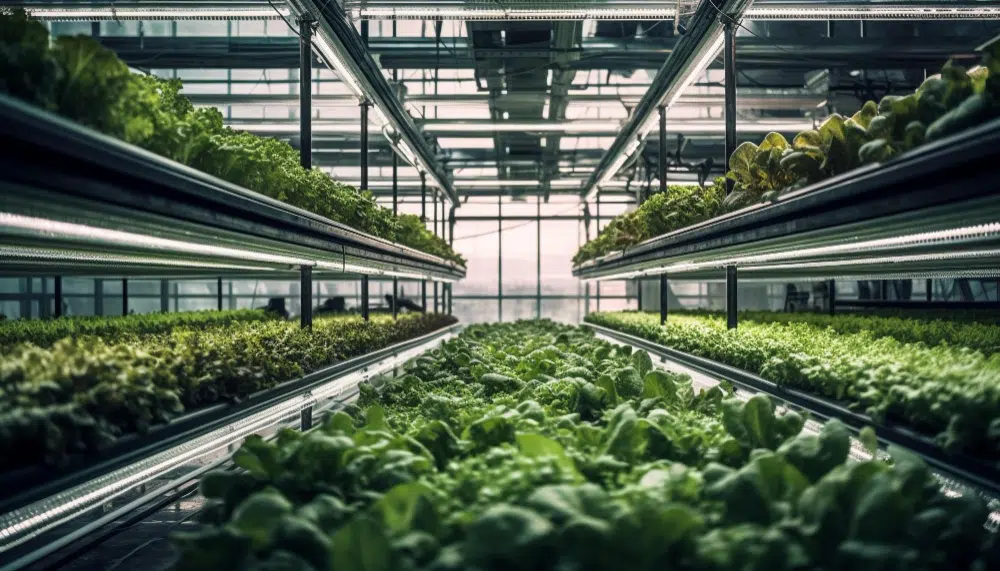
Vertical farming changes this relationship entirely. Within controlled-environment farms, light levels, humidity, temperature, airflow, nutrient delivery, and carbon dioxide levels can all be monitored and adjusted to optimise plant growth. This reduces reliance on unpredictable environmental conditions and enables year-round production regardless of external weather patterns.
For South Africa, where climate variability increasingly affects agricultural output, this level of control offers significant advantages. Instead of reacting to droughts, heatwaves, or excessive rainfall, growers can create stable growing conditions designed for consistent crop production.
The Soil-Free Revolution with Vertical Farming
One of the most transformative aspects of vertical farming is that it often eliminates the need for soil entirely.
Hydroponic systems deliver nutrients directly through water, while aeroponic systems use nutrient-rich mist. These methods allow plants to grow efficiently in controlled environments whilst using less water than conventional agriculture. Vertical farming systems can use up to 95% less water than traditional soil-based farming.
Removing soil from the equation also helps reduce:
- Soil degradation.
- Soil-borne diseases.
- Nutrient runoff.
- Dependence on pesticides.
For a water-scarce country such as South Africa, these efficiencies could play a significant role in improving agricultural sustainability.
Why IT Is Becoming as Important as Agriculture
The true engine behind modern vertical farming is not the infrastructure – it’s the technology.
Every aspect of a controlled-environment farm generates valuable data. Sensors continuously collect information about plant health, nutrient absorption, moisture levels, temperature, energy usage, and environmental conditions. This information is then analysed to improve performance and reduce waste.
AI-powered systems can help growers:
- Predict harvest times.
- Detect disease before it spreads.
- Optimise nutrient delivery.
- Improve water efficiency.
- Reduce operational costs.
- Enhance productivity.
This transformation highlights the increasing role of technology professionals in modern agriculture.
The future of farming will increasingly rely on:
- Artificial Intelligence.
- Data Science.
- Software Development.
- Cloud Computing.
- Internet of Things (IoT) technologies.
- Automation and Systems Engineering.
As agriculture becomes more data-driven, the distinction between technology companies and farming operations will continue to blur.
Urban Agriculture and Smarter Cities
Vertical farming is moving food production closer to the people who consume it. By converting rooftops, warehouses, and underutilised urban spaces into productive agricultural environments, cities can reduce their dependence on lengthy supply chains and imported produce. This creates opportunities for fresher food, reduced transportation costs, and improved food availability within communities.
For South Africa’s growing urban populations, technology-enabled agriculture could become a key component of future smart-city initiatives, integrating food production directly into urban infrastructure.
The Future of Food May Be a South African Technology Story
Vertical farming is often discussed as a global innovation, but some of its most compelling applications may emerge from countries facing significant resource and food security challenges.
South Africa’s combination of climate pressures, water scarcity, urbanisation, and technological innovation creates a unique environment for the growth of smart agriculture. Across the country, entrepreneurs, engineers, researchers, and technology professionals are already demonstrating how data, automation, AI, and controlled-environment agriculture can strengthen food production systems.
The future of farming will not simply be about growing more food. It will be about using technology to grow food smarter, more sustainably, and more efficiently. And South Africa has the opportunity not only to adopt this future – but to help lead it.
Frequently Asked Questions (FAQs) about Space Technologies
- What is vertical farming and how does it work?
Vertical farming is a method of growing crops in stacked layers inside controlled environments. It uses technologies such as LED lighting, hydroponics, aeroponics, sensors, and automation to optimise plant growth without relying on traditional farmland. - Why is vertical farming important for South Africa?
South Africa faces challenges including water scarcity, climate change, food insecurity, and limited agricultural land near urban centres. Vertical farming can help address these challenges by producing food efficiently using less water and space. - Are there successful vertical farms in South Africa?
Yes. South African organisations such as Arable Grow, Delta Dawn, and Future Farms SA are already implementing hydroponic, aeroponic, IoT-enabled, and controlled-environment farming systems. - How does technology improve vertical farming?
Technology helps monitor temperature, humidity, nutrient levels, water usage, and plant health. AI and data analytics can optimise production, detect issues early, and improve resource efficiency. - Does vertical farming use less water?
Yes. Vertical farming systems can use up to 95% less water than traditional farming methods because water is recycled and delivered directly to plants. - What role does AI play in vertical farming?
AI analyses data collected by sensors and automated systems to optimise growing conditions, predict harvests, improve efficiency, and identify potential issues before they affect production. - Can vertical farming improve food security?
Yes. By producing food closer to consumers and reducing dependence on unpredictable weather, vertical farming can help strengthen food security and increase access to fresh produce. - What careers are linked to vertical farming?
Vertical farming creates opportunities in software development, data science, AI, IoT, automation engineering, agricultural technology, and systems management. - What are the main challenges of vertical farming?
Challenges include high setup costs, energy requirements, technical complexity, and the need for specialised knowledge and infrastructure. - Could South Africa become a leader in smart agriculture?
South African companies and communities are already developing innovative farming solutions using technology, positioning the country to contribute valuable ideas and approaches to the future of global agriculture.
- Phillip Crafford, Belgium Campus iTversity