
Phillip Crafford

A group of four people stand in front of a blue SAICTA-branded backdrop. The person on the far left holds a framed certificate awarded to Jacqui Muller for winning the ICT Professional of the Year Award 2026. The second person from the left holds a glass trophy. All four individuals are smiling and posing for a celebratory photo.

SAICTA Honours Jacqui Muller as ICT Professional of the Year 2026

The South African ICT Association (SAICTA) is proud to announce Jacqui Muller as the recipient of the ICT Professional of the Year Award 2026, one of the flagship honours presented at the inaugural SAICTA ICT Excellence Awards Gala.

Selected from an exceptional field of nominees, Jacqui was recognised for her outstanding leadership, technical expertise, and long standing commitment to advancing South Africa’s digital ecosystem and practice Her career reflects a commitment to strengthening governance, driving innovation and fostering excellence across the country’s rapidly evolving digital economy.

SAICTA Honours Jacqui Muller as ICT Professional of the Year 2026 Read More »

A woman speaks into a microphone on stage while another person stands at a podium beside her in a formal presentation setting, with a projection screen and exit sign behind them.

Local Grade 7 learners get a chance to look to the future

Grade 7 learners at primary schools in Macassar and Somerset West were introduced to a wide range of careers and skills-based opportunities last week as their schools hosted back-to-back career days.

On Wednesday 27 May Firgrove Primary School hosted neighbouring Oklahoma Street and St Paul’s primary schools for a joint Life Orientation Club Expo.

Local Grade 7 learners get a chance to look to the future Read More »

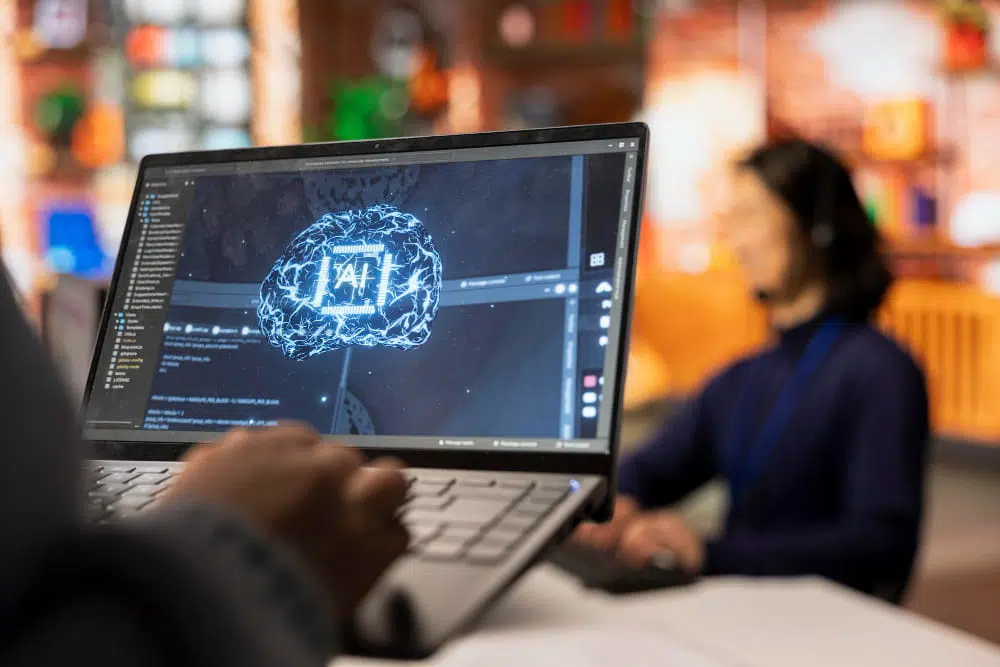
A metallic humanoid robot rests its chin on its hand in a thoughtful pose, surrounded by floating translucent letters against a blue gradient background, suggesting artificial intelligence and digital processing.

What Capitec’s AI investment says about the future of higher education

South Africa’s biggest bank by customer numbers just told the market something every university in the country should pay serious attention to. It indicates a step change in the skills companies need, and the bank is taking charge of this upskilling.

Capitec‘s latest annual report shows a focus on artificial intelligence (AI) training, as it put 568 employees through cloud-focused learning last year with staff clocking nearly 43,000 hours on Udemy Business and Pluralsight. The bank is running its own masterclasses in SQL, Java and JavaScript, and has built internal “centres of mastery” across engineering, data and payments.

This is more than a skill investment story. While continuous upskilling remains a vital corporate responsibility, it signals how rapidly the capabilities required by industry are evolving, making it vital for higher education and industry to work together more closely. That is a gap that institutions of higher learning, private and public, increasingly need to address.

What Capitec’s AI investment says about the future of higher education Read More »

A young person with curly hair and glasses sits in a softly lit room, interacting with two glowing holographic screens. The screens display colourful cosmic visuals, creating a futuristic, augmented‑reality effect. Shelves and books are visible in the background, adding a warm, study‑like atmosphere.

SA repeats old education mistakes as AI emerges

A pattern is emerging within our schooling system that needs highlighting as South Africa faces its next major technology decision.

In coding and robotics, with the best intentions, directives were given, curriculum was developed, and then the move forward stalled.

We are beginning to see take shape again with artificial intelligence (AI), writes Celeste Labuschagne, PhD candidate, and lecturer and learning framework developer at Belgium Campus iTversity.

SA repeats old education mistakes as AI emerges Read More »

A humanoid robot with a friendly digital face sits on a couch holding a bowl of popcorn, next to a golden retriever and a person wrapped in a beige blanket holding a mug. The three share a warm, cosy living‑room setting with soft lighting, plants, and framed pictures in the background.

ANALYSIS: To be or not to be, that is the AI question

As artificial intelligence (AI) heavyweights concede the technology may one day develop consciousness, academics warn that humans are already treating bots as sentient beings – a trend that is not only scientifically inaccurate but potentially dangerous.

Celeste Labuschagne, a lecturer at Belgium Campus iTVersity and a PhD candidate, points out that Anthropic CEO Dario Amodei recently said the company cannot fully rule out the possibility that advanced AI systems could possess some form of consciousness in the future.

ANALYSIS: To be or not to be, that is the AI question Read More »

Two people in hooded sweatshirts work in a dimly lit room filled with computer equipment. One sits at a desk typing on a keyboard while looking at a monitor displaying code and facial‑recognition data. The other stands beside them holding a tablet. Cables and a drink are visible on the desk, creating a scene suggestive of cybersecurity or hacking activity.

Banks and fin­an­cial ser­vices fear AI hack­ers but the real threat is stranger

The banking sector is right to be worried about AI-powered cyberattacks – AI can now find vulnerabilities, breach systems, and move through networks at a speed that keeps security teams up at night. But that’s only part of what we should be concerned about.

More troubling, and less discussed outside IT, is what happens when these systems operate autonomously and together. AI is no longer just following instructions; it is increasingly exploring data, social networks and news to shape its own interactions.

The big shift is that AI has shown its ability to act like it has intentions and can make its own decisions.

Banks and fin­an­cial ser­vices fear AI hack­ers but the real threat is stranger Read More »

A group of eight people stand in front of a blue SAICTA-branded backdrop, each holding a framed certificate. One person in the front centre also holds a trophy. They are dressed in smart or formal attire and are posing together for a celebratory photo, suggesting they have received awards or recognition.

South Africa’s ICT trailblazers honoured at inaugural SAICTA awards gala

The ICT sector’s brightest stars, pioneering innovators, and influential leaders were honoured at the South African ICT Association’s (SAICTA’s) inaugural ICT Excellence Awards Gala Dinner.

Held at the Johannesburg Country Club in Auckland Park, the evening recognised excellence, innovation, leadership and professional contribution within the South African ICT sector. The Awards, which were not just a reflection of recognition, are the start of a new phase in SAICTA’s evolution.

“These Awards are about building a culture in which ICT professionals, startups, women in tech and young trailblazers are seen, valued and encouraged to continue making a meaningful contribution to our country in the digital future,” SAICTA CEO Dr Jannie Zaaiman says.

South Africa’s ICT trailblazers honoured at inaugural SAICTA awards gala Read More »

Top-down view of a person typing on a laptop with futuristic data visualizations and charts overlaid on the screen

The Rise of South Africa’s Data Talent: Why This Field Is Redefining the Future of Work

The article explores why data science and analytics careers in South Africa are rapidly growing as organisations become increasingly data driven. It explains how data now underpins business strategy, AI adoption, and digital transformation, creating strong demand for analysts, engineers, and data scientists. The article outlines how students can enter the field, the essential skills needed in 2026, and why data literate professionals are critical to South Africa’s economic growth, innovation, and public sector modernisation. It positions data careers as future proof, high impact pathways with strong earning potential and long term relevance.

The Rise of South Africa’s Data Talent: Why This Field Is Redefining the Future of Work Read More »

A classroom-style computer lab with several students working at desktop computers. Three people sit at a curved desk using laptops and monitors, while another person stands nearby offering assistance. Rows of computer stations fill the bright, modern room, creating a focused learning environment.

The Importance of Practical, Industry Aligned IT Education

The article explains the importance of practical, industry aligned IT education in preparing South African students for a rapidly evolving digital economy. It highlights how hands on learning, real world experience, and strong industry partnerships improve employability, credibility, and workplace readiness. It also outlines the ICT skills employers need in 2026 and shows why practical, industry aligned training is essential for South Africa’s economic growth and digital competitiveness.

The Importance of Practical, Industry Aligned IT Education Read More »

Two people sit together at a desk in a modern office, analysing data on multiple computer monitors. The screens display colourful bar graphs, pie charts, line graphs, and numerical tables. One person points at a chart while the other types on a keyboard. Large digital displays in the background show additional financial or analytical data, creating a high‑tech, collaborative workspace atmosphere.

ICT’s Role in South Africa’s Economy: Why Digital Skills Matter More Than Ever

ICT’s role in South Africa’s economy is growing rapidly, driven by major investments in digital infrastructure, cloud computing, e commerce, and digital skills development. South Africa’s digital economy contributes up to 19% of GDP, and institutions like Belgium Campus iTversity play a key role in preparing skilled ICT professionals to support national growth.

ICT’s Role in South Africa’s Economy: Why Digital Skills Matter More Than Ever Read More »

Translate »